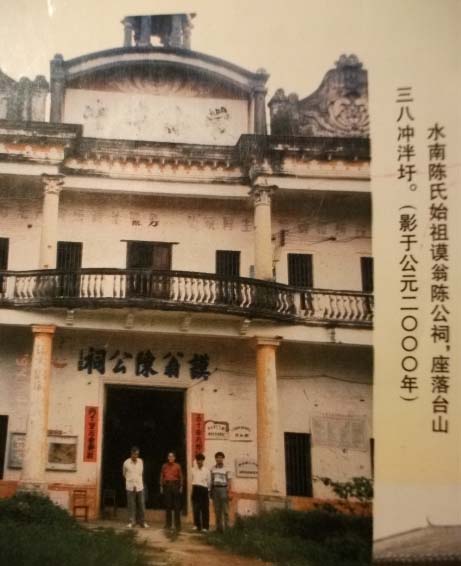
Chen Mo Memorial Hall in Taishan County Sanba Chongban Market
RECORDS FROM GREAT ANCESTOR MÓ
I passed the examination for my doctorate's degree and was appointed vice-president of the board of punishment [one of six ancient boards]. I could not take the position because it was necessary for me to flee and hide with my family.
I was born in the ninth year [1173 CE] of Emperor Qiandao's [Chinese: 乾道; pinyin: Qiándào; Hoisanva: Kẽin Ào] reign [during the Southern Song Dynasty] in Zhuji [traditional Chinese: 珠璣; simplified Chinese: 珠璣; pinyin: Zhūjī; Hoisanva: Jî Gï] Lane of the village of Shashui [Chinese: 沙水; pinyin: Shāshuǐ; Hoisanva: Sâ Suī] in the district of Baocheng [traditional Chinese: 保長; simplified Chinese: 保长; pinyin: Bǎocháng; Hoisanva: Bāo Chëng] in the prefecture of Nanxiong [Chinese: 南雄; pinyin: Nánxióng; Hoisanva: Nãm Hũng]. [The same Nanxiong to which Hu moved to.]
After the misfortune with my father, my whole family fled, including my six brothers, twenty-eight sons and brothers' sons, and thirty-something paternal male third cousins, and their wives. Some returned to their beloved home villages in Fujian [Chinese: 福建; pinyin: Fújiàn; Hoisanva: Fūk Gèin] Province. Some went elsewhere. My brothers said it would be difficult to live together. After traveling for many miles and unable to go any further, we settled in villages whose names had the "water" radical. We chose the "water" radical because we believe that water will eventually come together again and also in remembrance of our old village of Shashui [Chinese: 沙水; pinyin: Shāshuǐ; Hoisanva: Sâ Suī ]. [Notice the village of Shashui 沙水 where Mo was born not only had a "water" radical for sha 沙 (sand) on the left side but even the word shui 水, "water" itself.]
Some of us traveled by boat and some walked. My family finally reached the village of Gugongdehangli [traditional Chinese: 古岡德行里; simplified Chinese: 古冈德行里; pinyin: Gǔgāngdéhánglǐ; Hoisanva: Gū Göng Āk Hõng Lî] in Guangdong [traditional Chinese: 廣東; simplified Chinese: 广东; pinyin: Guǎngdōng; Hoisanva: Gōng Üng] Province. I have four sons. The first-born is Wenshen [traditional Chinese: 文詵; simplified Chinese: 文诜; pinyin: Wénshēn; Hoisanva: Mũn Xëin]. The second-born is Wenzhen [Chinese: 文振; pinyin: Wénzhèn; Hoisanva: Mũn Jīn]. The third-born is Wenlong [traditional Chinese: 文龍; simplified Chinese: 文龙; pinyin: Wénlóng; Hoisanva: Mũn Lũng]. The fourth-born is Wenqi [Chinese: 文起; pinyin: Wénqǐ; Hoisanva: Mũn Hī].
This is our ancestors' exhortation to our descendents --
"If this family tree is not cared for in three generations, then your are not filial and all will be lost. If you take care of the family tree, then all descendents will know our roots forever."
詩曰 Shī Yuē
追遠人心在孝思. 尋源天不歿埋碑.
山當華鄂前朝墓. 譜出南雄盛世時.
祀事猶明今日典. 曾孫須紹昔人基.
祖宗清白廊廟處. 何用樵人為指揮.
Zhuī yuǎn rén xīn zài xiào sī. Xún yuán tiān bù mò mái bēi. Shān dāng huá è qián cháo mù. Pǔ chū nán xióng chéng shì shí. Sì shì yóu míng jīn rì diǎn. Céng sūn xū shào xī rén jī. Zǔ zōng qīng bái láng miào chù. Hé yòng qiáo rén wèi zhǐ huī.
養浩祖過南雄感舊一律
珠璣塵跡遠. 野老半遺忘. 彷傳來沙水. 依稀到上方.
江山如舊在. 樓閣總新莊. 覽勝頻無算. 他鄉即故鄉.
Yǎnghàozǔ guò Nánxióng gǎn jiù yī lǜ
Zhūjī chén jì yuǎn. Yě lǎo bàn yí wàng. Páng chuán lái Shāshuǐ. Yī xī dào shàng fāng.
Jiāngshān rú jiù zài. Lóugé zǒng xīn zhuāng. Lǎnshèng pín wú suàn. Tā xiāng jí gù xiāng.
Our second generation Ancestor Grand Uncle Wenlong [traditional Chinese: 文龍; simplified Chinese: 文龙; pinyin: Wénlóng; Hoisanva: Mũn Lũng] was missing in action during the struggle between the Song [Chinese: 宋; pinyin: Sòng; Hoisanva: Xüng] and Yuan [Chinese: 元; pinyin: Yuán; Hoisanva: Ngũn forces].
The first generation started with our Great Ancestor Mo [traditional Chinese: 謨; simplified Chinese: 谟; pinyin: Mó; Hoisanva: Mũ], also referred to as Moweng [traditional Chinese: 謨翁; simplified Chinese: 谟翁; pinyin: Mówēng; Hoisanva: Mũ Yǔng]. He was born in 1173 C.E. and died in 1242 C.E. at the age of 69 and was buried in Ping'an [Chinese: 平安; pinyin: Píng’ān; Hoisanva: Pẽin Ön].